Render Cleaning

Protective treatment for render

Biocidal and water-repellent treatments applied to render after cleaning to slow algae returning, matched to the render type. What to expect and UK costs.

In short: A protective render treatment is a biocidal or water-repellent product applied to clean render to slow algae, mould and dirt coming back. It suits shaded, north-facing or tree-lined walls that green up quickly after cleaning. A protective treatment typically adds £1 to £3 per square metre to a render clean in the UK, depending on the product and render type.

Get a free quote

Fixed price, no obligation. We aim to reply the same day.

By sending this form you agree to be contacted about your enquiry. See our privacy policy.

Protective treatment for render

Cleaning removes the growth that is there today, but spores keep landing on the wall. A protective treatment helps the render resist them for longer. Most are either a residual biocide, which stays on the surface and kills new growth as it starts, or a water repellent, which reduces how long the wall stays damp. Some products combine both. They are applied once the wall has been cleaned and rinsed, usually at low pressure or with a sprayer.

The right product depends on the render. Silicone render already repels water, so a residual biocide is usually the useful part. Monocouche, sand-and-cement and painted render can benefit from a breathable water repellent, but it must let moisture out of the wall as well as keep rain off, or it can trap damp. Where a render system has a manufacturer's guarantee, check the manufacturer's advice on which treatments are compatible before anything is applied.

What is included

  • Advice on whether a treatment is worthwhile for your walls
  • Choosing a biocidal, water-repellent or combined product
  • Checking compatibility with the render type and any guarantee
  • Applying the treatment evenly after cleaning
  • Avoiding glazing, paintwork and planting during application
  • Guidance on drying time and weather conditions
  • Advice on when to re-treat or maintenance clean

Who it is for

  • North-facing walls and gable ends
  • Walls shaded by trees, hedges or neighbouring buildings
  • Rural and coastal homes with heavy algae growth
  • Homes where render greened up quickly after a past clean
  • Managing agents wanting longer gaps between cleans

How much does it cost?

As a guide, a protective treatment usually adds £1 to £3 per square metre to a render clean, or roughly £100 to £300 for a typical semi-detached house. See our full cost guide.
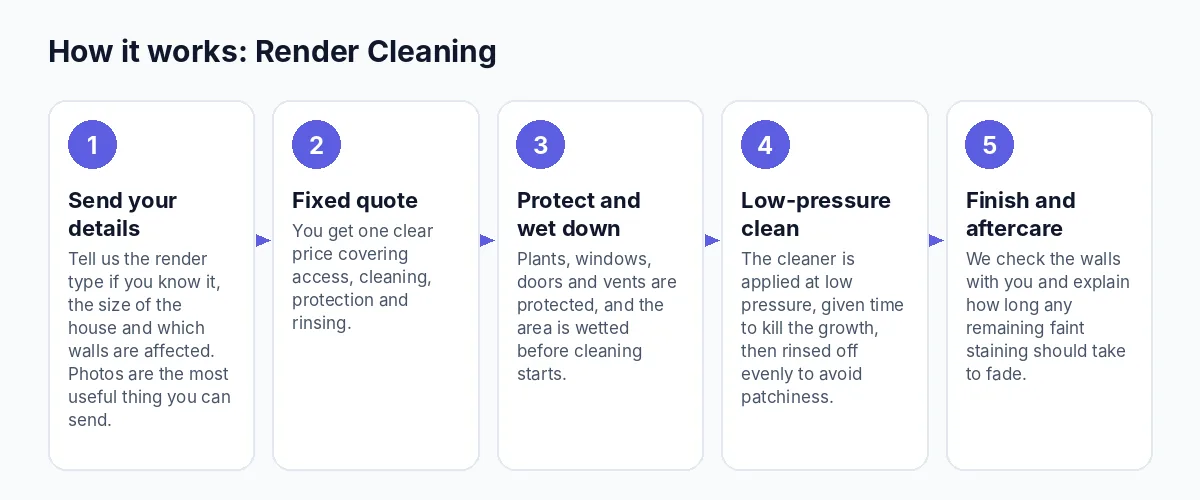
How it works

How protective treatment for render works, step by step
  1. Assess the walls

    Shading, nearby trees, exposure and render type are considered to decide whether a treatment will help and which one.

  2. Clean first

    The render is cleaned and rinsed so the treatment goes onto a clean surface free of live growth.

  3. Apply evenly

    The treatment is applied at low pressure across whole elevations for an even, consistent coat.

  4. Allow to cure

    The product is left to dry in suitable weather, and you are told when to expect re-treatment or a maintenance clean.

Protective treatment for render: FAQs

How long does a protective treatment last?

It varies with the product, the render and how exposed and shaded the wall is. Many treatments help keep render clean for several years, but on very shaded or tree-lined walls growth may start to return sooner. A light maintenance clean and re-treatment every few years keeps the walls looking fresh.

Will a water repellent stop my render breathing?

A good-quality breathable water repellent is designed to reduce rain soaking in while still letting water vapour escape from the wall. Non-breathable coatings can trap moisture and cause problems, especially on older solid walls. The product should be chosen to suit the render and the building.

Can a treatment be applied without cleaning first?

It should not be. Applying a treatment over live algae, mould or dirt means it cannot bond to or protect the surface properly, and it can lock in staining. Render should be cleaned, rinsed and allowed to dry as the product requires before a protective treatment goes on.

Is protective treatment worth the extra cost?

On sunny, open walls that rarely go green, it may not be needed. On north-facing, shaded or tree-lined walls, where growth returns fastest, a treatment usually extends the time before the next clean enough to cover its cost. We will say honestly which walls are likely to benefit.

Get a quote for protective treatment for render

Send a few details and get one clear, fixed price, usually the same day.

Get a quote

Last updated 6 November 2026